
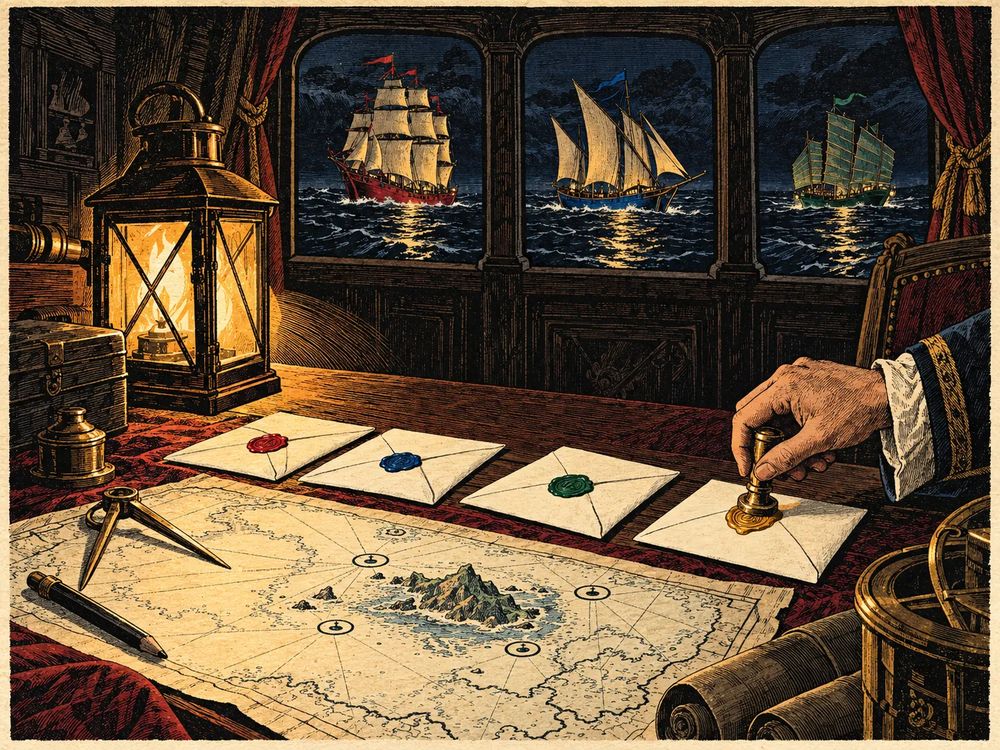
The rules on one card
Fog has settled over the archipelago, and every fleet sails under false colors. A ship's rating is a secret until she fights. You command 14 ships: hold the harbors, capture enemy Admirals and keep your own afloat. There are no dice.
- Bigger number wins. Same number, both sink.
- Three exceptions. A Fireship (X) sinks whoever attacks her, except a Boarding Party (3). A Privateer (1) sinks a First Rate (7), only when she attacks. Anyone can capture an Admiral (A).
- Orders. Each round, give up to 3 ships one order each, 4 while your Admiral is afloat. Everyone moves at once. Round 1 is a truce.
- Cutters. A 2 sails up to 3 cells in a line, or spyglasses a neighbor.
- Harbors and the storm. Hold harbors to score. The storm closes in from the edges. 24 rounds.
Setting up
These rules use the square chart, 12 by 12. The duel and hex charts set up the same way; see Charts, seats and modes.
- Each captain takes the 4 by 4 anchorage in the middle of one edge and sits at that side of the table. Two captains take opposite edges. Four captains take one edge each; in pairs, partners sit on neighboring edges, side by side.
- Place all 14 ships anywhere in your anchorage, ratings toward you. Two cells stay empty. Fireships and the Admiral may stand in the front row if you dare.
- Wings, if the table agrees before setup: a fleet may also start in the 2 by 2 of open water on each side of its anchorage along the edge, 24 cells in all.
- Once every fleet is placed, nobody may change a placement. Set the round marker to 1.
In the digital game every fleet starts in the standard formation, and a captain may rearrange it or ask for a random layout, dealt from a source no other seat can see.
The fleet
Every captain has the same 14 ships. The number on a ship is her rating; bigger beats smaller. Three ships have no rating and break the rule instead. The Square-Riggers are drawn here; every fleet carries the same roster.
| Ship | Name | In the fleet | Rating | Moves | Note |
|---|---|---|---|---|---|
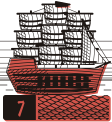 7 7 | First Rate | 1 | 7 | 1 | Loses only to a Privateer that attacks her. |
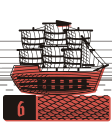 6 6 | Ship of the Line | 1 | 6 | 1 | |
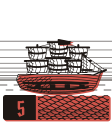 5 5 | Frigate | 1 | 5 | 1 | |
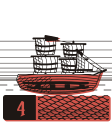 4 4 | Sloop | 2 | 4 | 1 | |
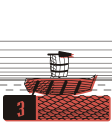 3 3 | Boarding Party | 2 | 3 | 1 | Captures a Fireship instead of burning. |
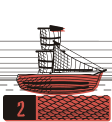 2 2 | Cutter | 3 | 2 | up to 3 | Sails up to three cells in a line; may spyglass a neighbour instead of moving. |
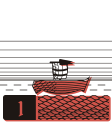 1 1 | Privateer | 1 | 1 | 1 | Beats a First Rate when attacking; loses to every other rated ship but another Privateer. |
 X X | Fireship | 2 | none | 0 | Never moves. Burns any attacker except a Boarding Party. |
 A A | Admiral | 1 | none | 1 | Never attacks. Any attacker captures her: 8 points to the captor. |
Who beats whom
A ship that sails into another's cell attacks her. Read across from the attacker to the defender. Fireships and Admirals never attack: a Fireship never moves, and no legal order sails an Admiral onto an enemy ship.
| att. \ def. | 7 | 6 | 5 | 4 | 3 | 2 | 1 | X | A |
|---|---|---|---|---|---|---|---|---|---|
| 7 | = | ✓ | ✓ | ✓ | ✓ | ✓ | ✓ | ✕ | ⚑ |
| 6 | ✕ | = | ✓ | ✓ | ✓ | ✓ | ✓ | ✕ | ⚑ |
| 5 | ✕ | ✕ | = | ✓ | ✓ | ✓ | ✓ | ✕ | ⚑ |
| 4 | ✕ | ✕ | ✕ | = | ✓ | ✓ | ✓ | ✕ | ⚑ |
| 3 | ✕ | ✕ | ✕ | ✕ | = | ✓ | ✓ | ✓ | ⚑ |
| 2 | ✕ | ✕ | ✕ | ✕ | ✕ | = | ✓ | ✕ | ⚑ |
| 1 | ✓ | ✕ | ✕ | ✕ | ✕ | ✕ | = | ✕ | ⚑ |
- the attacker wins
- the attacker loses
- both sink
- the Admiral is captured
- Bigger rating wins. Equal ratings both sink.
- The Fireship (X). Any ship that attacks a Fireship burns. A Boarding Party (3) takes her instead.
- The Privateer (1). Attacking a First Rate (7), she wins. A First Rate that attacks her sinks her.
- An Admiral (A). Any ship that reaches her captures her: 8 points to the captor. Lose her and you sail on.
A fight is shown only to the two captains in it and their partners, and the loser leaves the chart. Sinking a ship scores half her rating, rounded down: a First Rate is worth 3, a Cutter 1.
A round
Every round has the same four steps. There is no turn order: every captain acts together.
- Write orders. In secret, give up to 3 of your ships one order each, or 4 while your Admiral is afloat. A ship without an order holds.
- Reveal. Every captain shows their orders at the same moment. Online, the round resolves when the last captain's orders are in.
- Resolve. Spyglasses first. Then every ship moves one cell together; Cutters with cells left move a second and a third step. Ships that meet fight.
- Score. Count the harbors and the Capital. Advance the round marker. After rounds 13, 18, 22 the storm takes the next ring.
The truce. Round 1 is a truce: no ship may sail onto an enemy, ships that would meet hold where they are, and two ships that would swap cells pass each other. Spyglasses still work.
Orders
- Move. One cell along a row or column, never diagonally, into open water or onto an enemy ship, which is an attack. Never onto an island or a cell the storm has taken.
- Cutters sail one, two or three cells in a straight line through empty water, and may attack at the end of the run.
- Spyglass. Instead of moving, a Cutter beside an enemy ship may look at her. You learn her rating; her captain learns which Cutter looked.
- Hold. The ship stays. A ship you gave no order holds too.
- Onto your own ships. A ship may sail onto a cell held by her own fleet or a partner, never onto her own Fireship. If that ship sails away the same round she follows in behind; if not, she holds. Two ships of one fleet may swap cells.
- An Admiral may not be ordered onto an enemy ship.
- No shuffling. A ship may not sail back to the cell she just left when her last 3 rounds already went back and forth between the same two cells.
The digital game names the rule that refuses an order, so nobody has to remember all of this.
When ships meet
Because every ship moves at once, the rules say exactly what happens when courses cross.
- A ship entering a cell that another ship is leaving passes in behind her. No fight.
- A ship entering a cell whose ship stays attacks her.
- Ships entering one empty cell fight there, two at a time, in order of entry: the stronger first, then the lower seat. The survivor meets the next. The digital game settles any remaining tie by where the ships started.
- Two ships that swap cells meet head-on and fight, equal ratings included. Between two moving ships, the one first in order of entry attacks.
- Two moving ships of equal strength sink each other, Admirals included, so two Admirals that meet are both lost.
- An Admiral attacked by a ship entering her cell is captured. An Admiral who sails for a cell where a ship stays bounces back to her own.
- Teammates never fight.
There is no take-back after the reveal. A feint costs a real round, which is why the bluff matters.
What each captain knows
- A fight shows both ships to the two captains in it and to their partners. Everyone else learns where it was and which ships were struck.
- A ship that wins a fight stays on the chart, known only to those who saw the fight.
- A spyglass is seen by the two sides it touches and by nobody else.
- An Admiral lost without being captured is shown to everyone.
- Partners see each other's ships and pending orders. Under Sealed Orders they see only what each has learned, and must signal their plans to a partner who cannot see their ratings.
- In Open Water (three or more captains, each alone) the running scores are hidden. Each captain sees their own score and a band for the others: leading, close (within 5 of the leader) or trailing. The leader and lead changes stay hidden until the end.
- A shared screen, a spectator or the party screen sees where every ship is and nothing of what she is.
In the digital game this is built in: each captain sees only what their own seat can see, and the rival captains play from the same views, never from the true chart.
Scoring
- 1
- A harbor. To the captain whose ship stands on it at the end of each round.
- 2
- The Capital. At the end of each round, to the side with the most ships on its cells. A tie scores nothing.
- 8
- An Admiral captured. To the captor. Her captain sails on and keeps every point won.
- ½
- A ship sunk in a fight. Half her rating, rounded down, to the winner.
- +4
- Admiral afloat. To each captain whose Admiral is still afloat when the game ends, however it ends.
- −8
- Admiral lost. An Admiral lost without being captured, to the storm or by meeting another Admiral, costs her own captain this much, and she is shown to everyone.
Harbors pay every round, so a fleet that hides in its anchorage falls behind one that sails for the center. Fights pay little on purpose: they reward a good trade without turning the game into a brawl. In a team game, partners' scores are added together.
The storm
After rounds 13, 18, 22 the next ring of the chart, counted from the edge, is lost to the storm, islands too. Any ship still on it is lost. The rings and their rounds are printed on every chart, so a watchful fleet need never lose a ship to the weather, but a Fireship set up on the edge goes down with her ring.
No stalling. After 6 rounds running with no fight and no harbor or Capital changing hands, every ring still three or more rounds away closes a round early.
How a game ends
Classic
The classic game ends after round 24, and the most points wins. It ends at once when one side has captured every enemy Admiral, and that side wins whatever the points. With two captains it also ends, on points, once neither side can capture any more. The bonus for an Admiral afloat applies however it ends.
Ties. On equal points, more harbors held in the last round wins, then more enemy strength sunk. Failing both, the result is shared.
Other endings
The host may choose another ending before the game.
- Last Admiral afloat. A captain whose Admiral is captured or lost leaves the board with the whole fleet. The last side with an Admiral afloat wins.
- Capture the flag. The first side to capture an enemy Admiral wins at once. A captain whose Admiral is lost uncaptured leaves the board. The host chooses whether to play with harbor points and the storm, or without harbor points and with a storm that starts late.
- Hold the Capital. A side whose ships hold the Capital at the end of 2 rounds running wins: every cell of it with two sides, most of its cells with three or more.
Under these the round limit still stands unless the host lifts it, in which case the storm keeps closing a ring every few rounds until only the Capital is left. If the limit is reached, points decide.

The Black Flag mode
Pirates!
One captain is the pirate and sails the Buccaneers; every other captain is a navy, and the navies are one alliance. Three navies play against the pirate on the square chart, two to five on the hex chart.
- Allies. The navies never fight each other, but each sees only her own ships and what the alliance learns of the pirate's in fights and by spyglass.
- Orders. The pirate gives 4 orders a round and each navy 3, each one more while their Admiral is afloat.
- Boarding. A pirate ship that attacks and wins takes the beaten ship as a prize instead of sinking her, never an Admiral or a Fireship. The prize is sailed into the cell the winner came from; with no room there she sinks. The pirate holds at most 4 prizes; at the limit a beaten ship sinks.
- Prizes. A prize keeps her rating, shown to everyone from then on, and sails for the pirate once her new crew is aboard: the round after she is taken, she holds.
- Ransom. A prize that ends a round on a harbor or a Capital cell is sold, and her rating goes to the pirate's plunder. A prize still held at the end counts half.
- Retaking. A navy ship that attacks a prize and wins takes her back to her own fleet, and scores half her rating.
- Plunder. The pirate scores only plunder: ransoms, prizes held at the end, 8 for a captured Admiral and 4 for her own Admiral afloat at the end. Plunder of 12 on the square chart, or 9 on the hex chart, wins at once.
- The alliance wins when the pirate's Admiral is gone, or with the higher score at the end, counted as the navies' average.
- The escape. The first time the pirate's Admiral is attacked and beaten, she slips away in a gig to an open cell beside her, and is known to everyone from then on. The next time she is taken.
Pirates!, the other endings and the options on two printable pages (PDF)
Charts, seats and modes
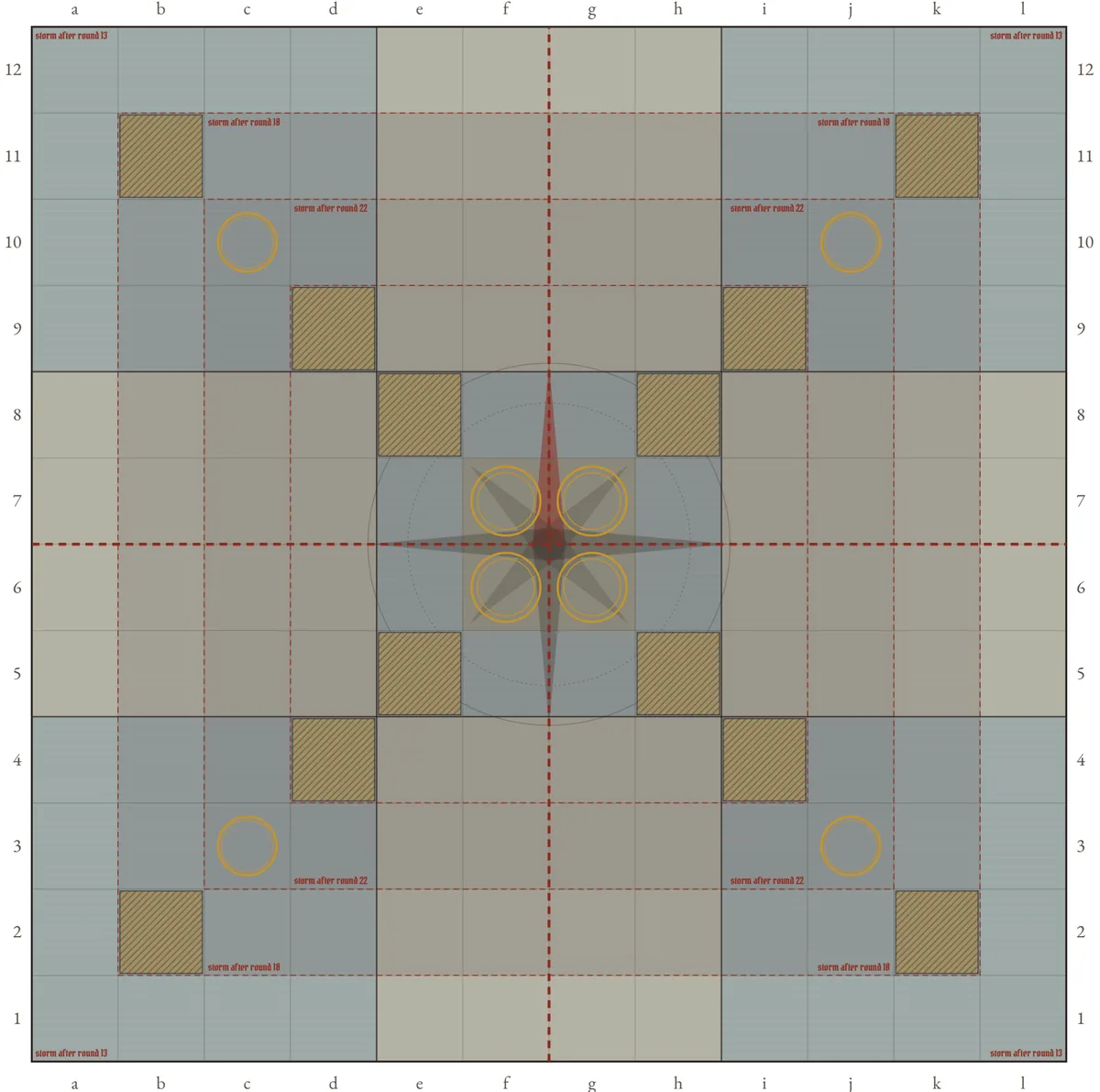
- The square chart
- 12 by 12, for two or four captains. Four anchorages of 4 by 4 in the middle of the edges, four harbors on the corner diagonals midway between neighboring anchorages, islands that screen neighbors from each other, and a 2 by 2 Capital open on every side.
- The duel chart
- 10 by 10, for two captains on facing edges, with two harbors and a 2 by 2 Capital. It is still under test.
- Six Captains, the hex chart
- A hexagon of radius 8, for three to six captains, and two can play it too. Six anchorages of 16 hexes at the corners, six harbors midway between them, and a Capital of seven hexes. Ships sail one hex in any of six directions, Cutters up to 3 in a straight line.
Modes
- Open Water. Every captain alone. With three or more, the running scores are hidden.
- Pairs. Partners share a score and see each other's ships. On the square chart partners sit on neighboring edges. Capturing both enemy Admirals wins at once.
- Triads. Six captains on the hex chart, in two teams of three.
- Pirates! One pirate against an alliance of navies, above.
Variants
Off unless the table chooses them, except where it says otherwise.
- Sealed Orders. The hard team game: partners do not see each other's ratings or orders, only what each learns in fights and by spyglass.
- Wings. On the square chart, a fleet may also start in the 2 by 2 on each side of its anchorage.
- Random islands. The islands are dealt for each game with the chart's symmetry, so every seat has the same map.
- Command. A ship beside her own Admiral wins an even fight instead of both sinking.
- Admiral's spyglass. An Admiral may look at an adjacent enemy instead of moving, as a Cutter does.
- Admiral's order. On by default: one more order a round while your Admiral is afloat. The table may play without it.
- Admiral lost. The cost of an Admiral lost uncaptured: none, 4 or 8 points; 8 by default.
- Sunk Admirals count as gone for the early win, so a side that has captured every other enemy Admiral wins at once.
- The truce. On by default; the table may start fighting from round 1.
- Wind, on the hex chart. Nothing sails straight into it except Boarding Parties and Cutters; a ship sailing straight downwind may go two hexes; it veers one point clockwise after rounds 6, 12 and 18.
Rules can still change during the beta.
The print kit
Free, with no signup. Print at 100 percent, not "fit to page", on letter paper; heavy stock lies flatter.
- The rulebook 4 pages: the rules, the other endings and options, and Pirates!
- The rules card alone 2 pages
- The square chart 4 sheets and an assembly page
- The duel chart 4 sheets and an assembly page
- The hex chart 6 sheets and an assembly page
- The hex chart on one page an overview, landscape
- Ship tokens 4 sheets, one per fleet