The custom of the sea
At sea a flag was the first thing anyone could read about a ship. Seen from a few miles off, a stranger might be a friend, a neutral trader or an enemy, and her colours were the only introduction she gave. That made them worth faking. Captains flew other nations' ensigns, painted their ships to pass for someone else's, and kept their gunports shut to look like merchantmen.
What a ship could not do was fight in disguise. The rule that grew up was simple: she may sail under any flag, but before she opens fire she must hoist her own. The United States Navy's handbook on the law of naval operations still states it as customary law. A warship may fly false colors to deceive an enemy, but "it is unlawful for a warship to go into action without first showing her true colors."1
The rule has been written down more than once, and not always the same way. When the British Admiralty armed merchant ships for self-defence in the First World War, its instructions of 20 October 1915 included one plain line:
Before opening fire the British colours must be hoisted.
Two years earlier the Institute of International Law, meeting at Oxford, had drafted a manual of the laws of naval war that went further and listed false flags among the forbidden methods of war at sea.3 It was a scholars' manual, not a treaty. The San Remo Manual, the restatement of the law of armed conflict at sea adopted in June 1994, came back to the older line: ruses of war are permitted, but warships "are prohibited from launching an attack whilst flying a false flag."4
False Colors turns the bargain round. In the game your flag never lies: every ship flies her own fleet's ensign. What you hide is her strength, and as in the old rule it only shows when she fights. Even then, only the two captains in the fight learn what they met.
Two disguises, one meeting
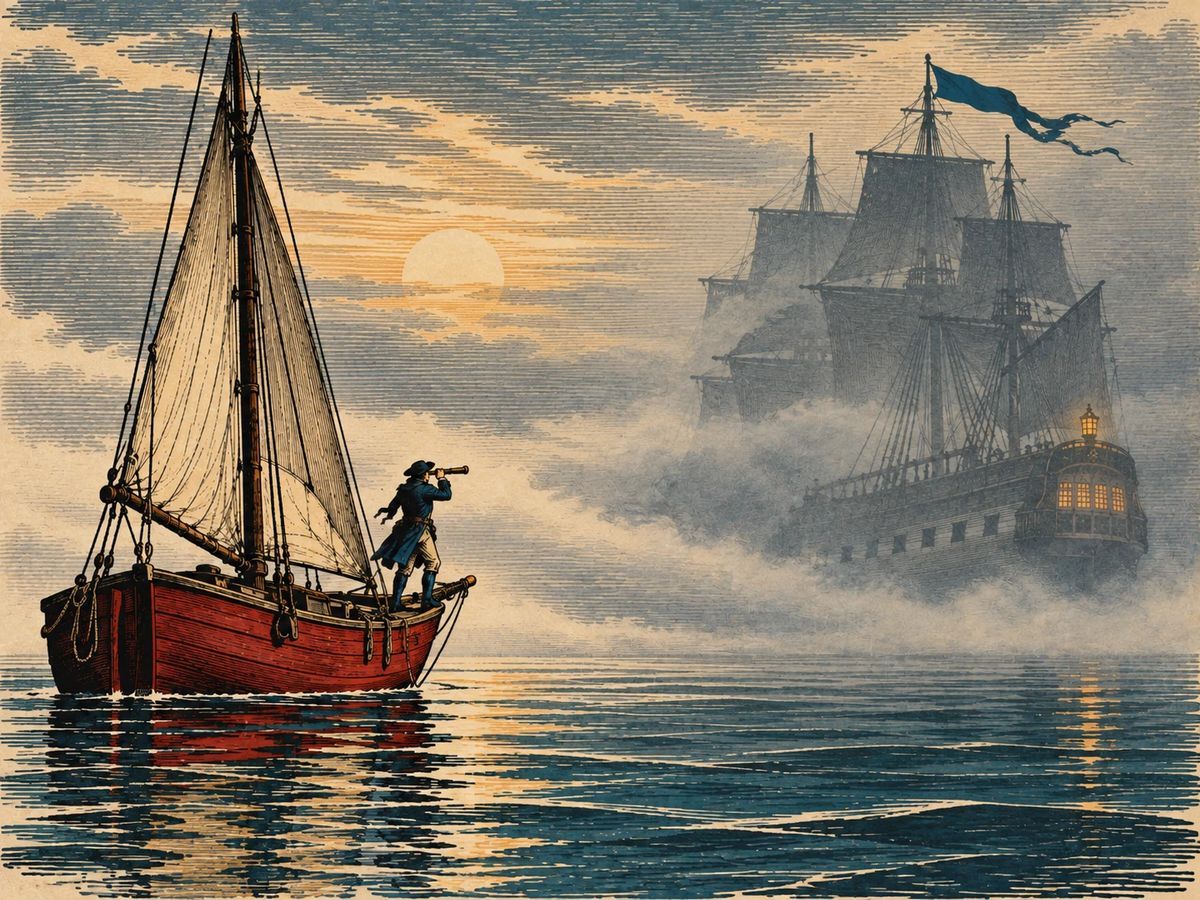
The best-documented ruse of the sailing age is Lord Cochrane's, and he told it himself. In 1800 he commanded HMS Speedy, a brig of 158 tons armed with fourteen 4-pounders, raiding Spanish shipping in the western Mediterranean. Warned at Mahon that the Spaniards meant to catch him, he had Speedy painted to look like the Clomer, a Danish brig well known on that coast, and shipped a Danish quartermaster with an officer's uniform.5
On 21 December 1800 Speedy gave chase to what looked like a well-laden merchantman. As she closed, the merchantman raised her ports and showed a heavy broadside: she was a Spanish frigate with her crew hidden below, out looking for Speedy. Cochrane hoisted Danish colours. When the frigate sent a boat to board him, he ran the yellow quarantine flag up to the fore, and his Danish officer told the Spaniards they were two days out of Algiers.
Two days from Algiers, where at the time the plague was violently raging.
That was enough. The boat went back, and the frigate wished them a good voyage and made sail. Both ships had come to the meeting in disguise, one dressed as a trader and one as a neutral, and since neither fired, neither ever had to show her colours.
Five months later, on 6 May 1801, Cochrane met the Spanish xebec frigate El Gamo off Barcelona and this time chose to fight. She fired a gun and hoisted Spanish colours. Speedy answered with American colours, to puzzle her until Speedy had come round onto the other tack, and then ran up the English ensign; only after that did the broadsides begin. The disguise ended exactly where the custom said it must.5
Hiding strength worked as well as hiding a flag. When Lieutenant Robert Maynard of the Royal Navy came for Blackbeard at Ocracoke, North Carolina, on 22 November 1718, he kept many of his men below decks, disguising his true strength. Blackbeard was killed in the fight that followed.6
The pieces, and the history in them
Every ship in a False Colors fleet has a namesake that sailed. Here is what each one did, and what the game kept.
Fireships
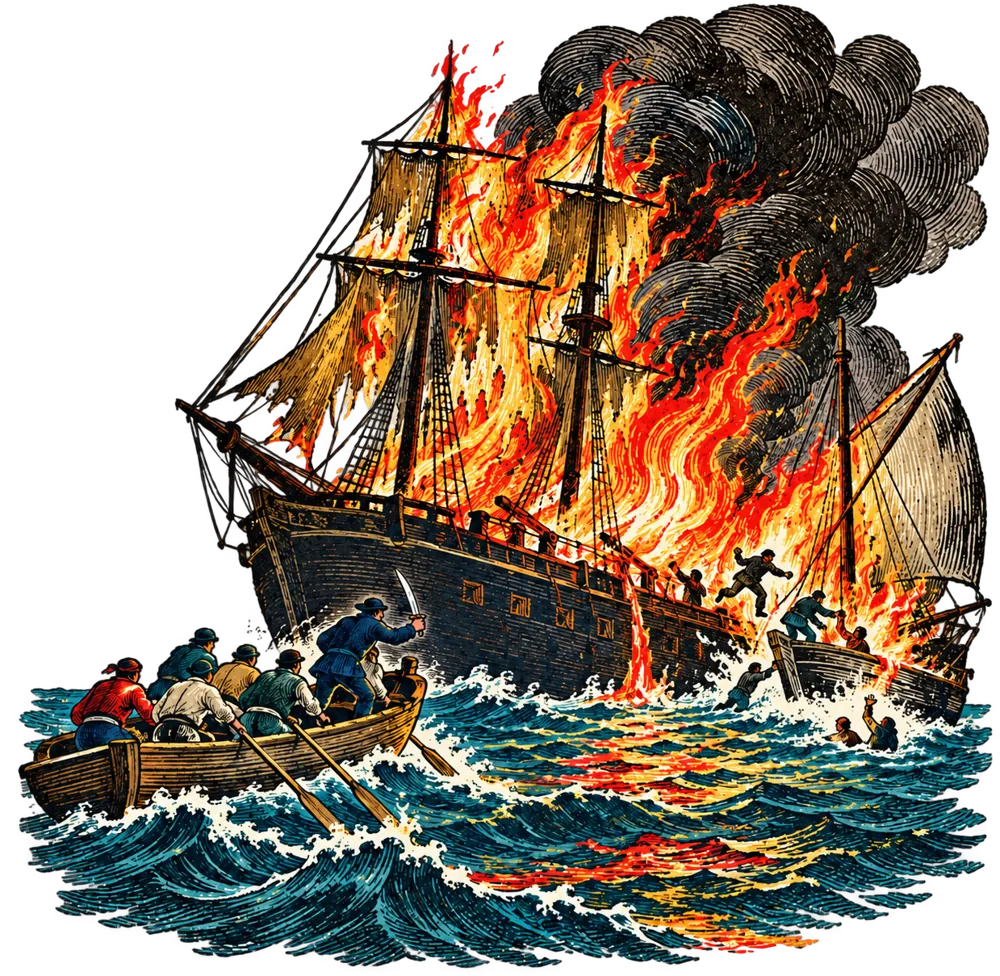
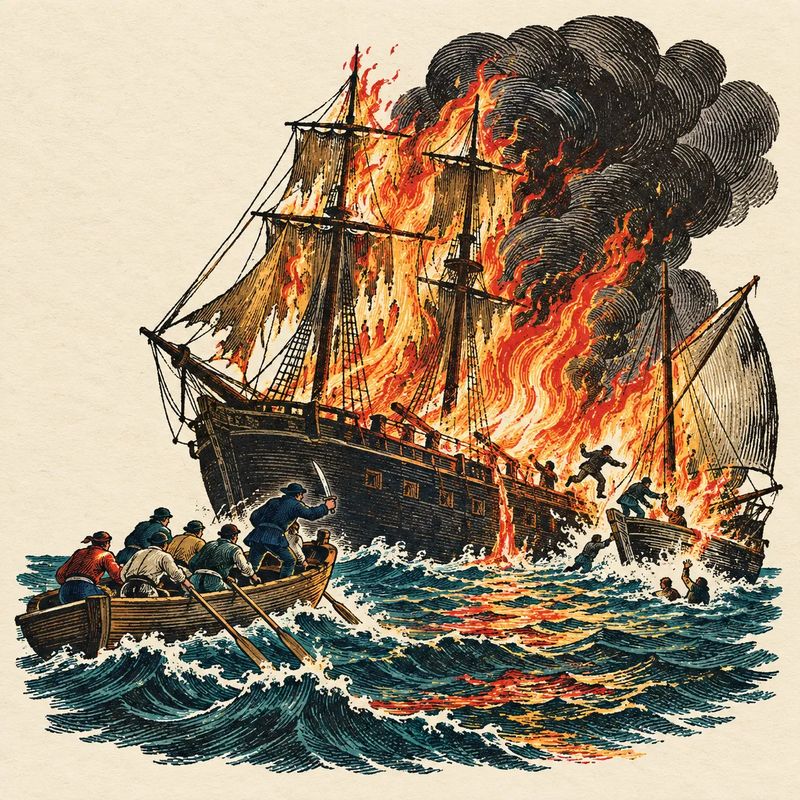
On the night of 7 August 1588 the Spanish Armada lay at anchor off Calais. Sir Francis Drake, second in command of the English fleet, sent in eight small ships packed with anything that would burn, and set them alight among the anchored Spanish ships. In the confusion the Spanish captains cut their anchor cables to save themselves, and the fleet never regained its anchorage.7
The date is 28 July by the calendar England used at the time, which ran ten days behind the one Spain used.
 In the game the Fireship never moves. Any ship that attacks her burns, except a Boarding Party, which takes her.
Privateers
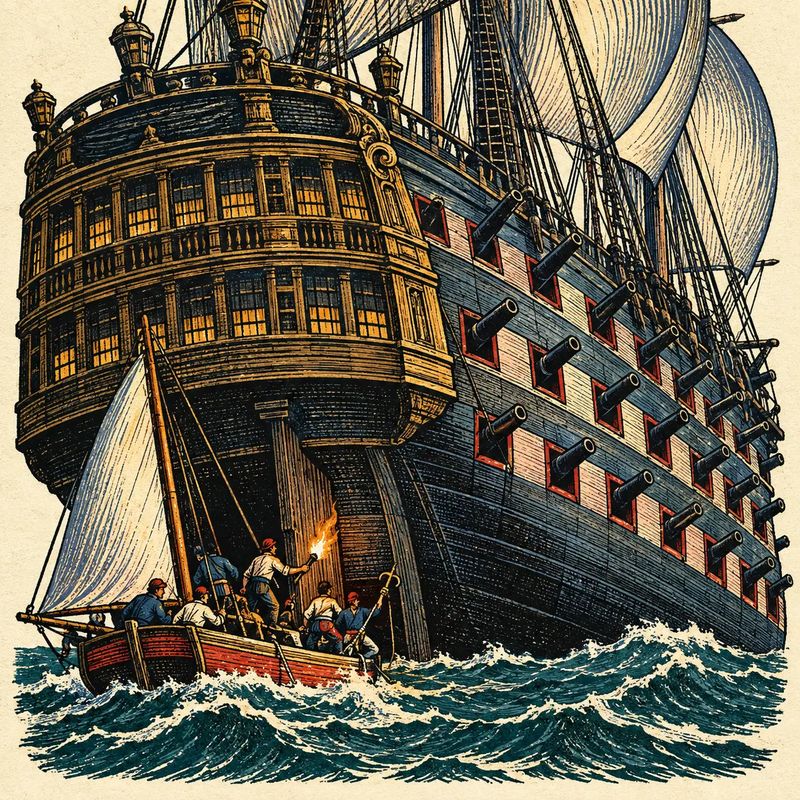
A privateer was a privately owned ship licensed in wartime to take enemy vessels. The licence was a letter of marque. It was the evidence that she acted for her government and was not a pirate, and its captain kept the original while a copy stayed in the records of the High Court of Admiralty.8 During the American Revolution alone, Britain issued 7,352 of them.8
Before sailing, each commander had to swear a declaration giving the details of the ship, her guns, her crew and her officers. The registers of those declarations survive at The National Archives for 1689 to 1808.9
The line between privateer and pirate was a piece of paper, and men crossed it. Blackbeard is thought to have sailed as a privateer in Queen Anne's War before he turned pirate when it ended.10
 In the game the Privateer is the smallest ship afloat and the only one that can sink a First Rate, when she attacks. That part is the game's invention, not history.
Cutters and spyglasses
The cutter was the coast's quick ship: a big gaff-and-boom mainsail, a square topsail, a foresail and a jib run out on a long bowsprit. Revenue services used large numbers of them to patrol for smugglers. The Royal Navy kept few in peacetime but hired or bought them in great numbers in war, to hunt privateers in the Channel and the North Sea, where their speed and shallow draught let them work close inshore, in creeks and estuaries.11
 In the game the Cutter sails up to 3 cells in a straight line, and instead of moving she may look through her spyglass at a ship beside her and learn her rating. Only the two captains know she looked.
Nelson's Patent Bridge for boarding first-rates.
Boarding parties
A ship could be taken without being sunk, by laying her alongside and carrying her deck with men. At Cape St Vincent on 14 February 1797, Commodore Nelson in the Captain, 74 guns, left the British line to block the Spanish escape and boarded the San Nicolas, 80 guns. She had run foul of the San Josef, 112 guns, and Nelson led his men on across her into the bigger ship and took her too.12
Cochrane took El Gamo the same way in 1801, with 54 officers, men and boys against 319. Once his crew was on her deck, he had one of them haul down the Spanish colours; her crew, believing their own officers had struck, gave in.5
 In the game the Boarding Party is a 3, and the only ship that can take a Fireship instead of burning.
The First Rate
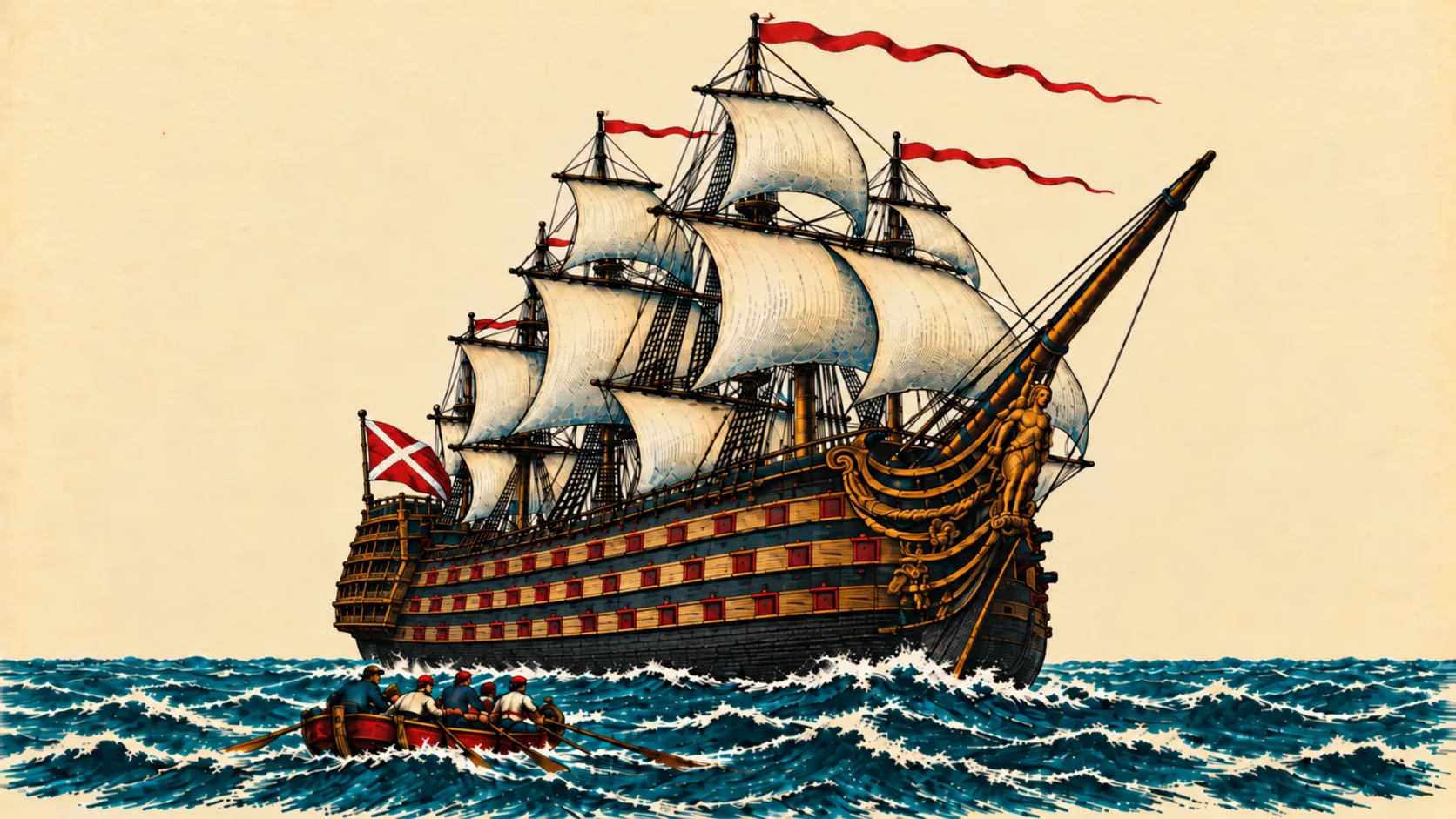
Navies rated their ships by size and guns, and the first rates stood at the top: three-deckers of a hundred guns or more.13 HMS Victory is the one that survives. Designed by Sir Thomas Slade and launched at Chatham on 7 May 1765, she carried 104 guns and was Nelson's flagship at Trafalgar on 21 October 1805. She has stood in dry dock at Portsmouth since the 1920s and is still a commissioned ship of the Royal Navy.14
 In the game the First Rate is a 7. Nothing afloat outguns her; her one weak spot is a Privateer that attacks her.
Admirals taken at sea
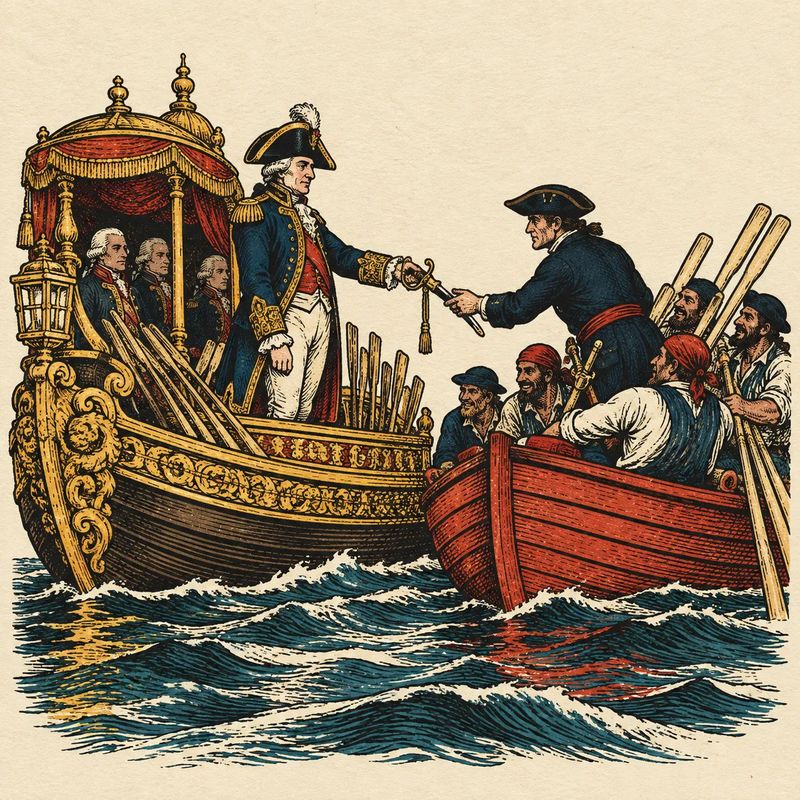
An admiral flew his flag in one ship, and taking that ship could take him with her. At Trafalgar the French admiral Pierre-Charles Villeneuve commanded the combined French and Spanish fleet from the Bucentaure. Her masts came down one after another, and he surrendered. His own report of the battle is dated 15 November 1805, written as a prisoner of war aboard the British frigate Euryalus.15
 In the game the Admiral never attacks. Any ship that reaches her captures her, for 8 points, and her fleet fights on. Lose her any other way, to the storm or to another Admiral, and her own captain loses 8.
Signals and sealed orders
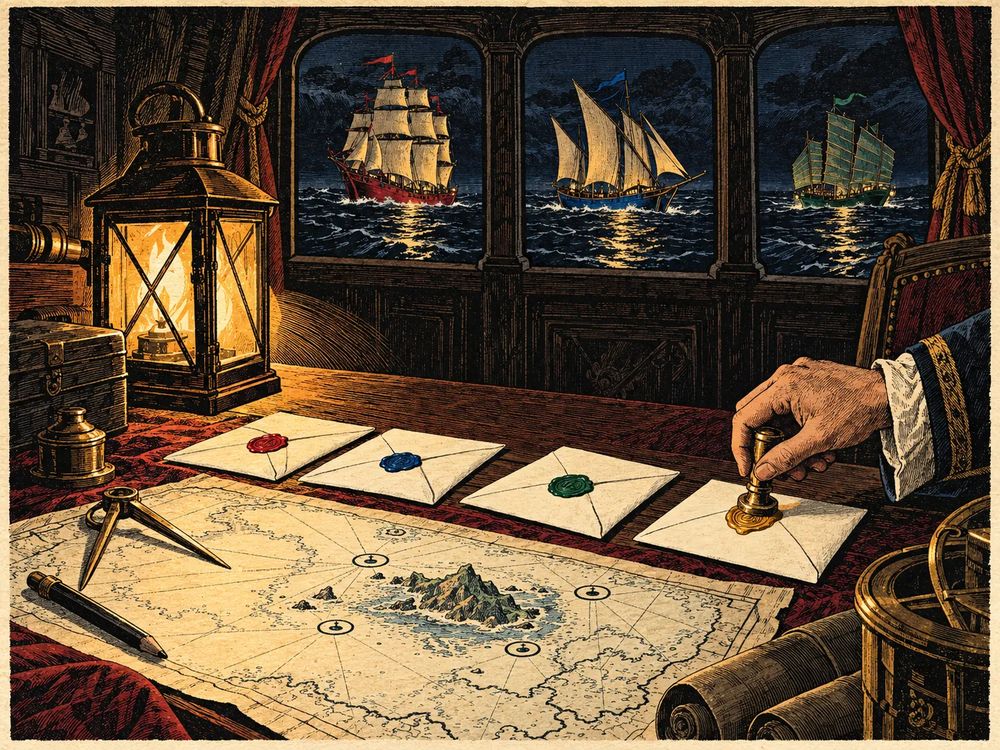
Fleets talked in flags. At Trafalgar the Royal Navy used Sir Home Popham's signalling system, which sent whole words from a set vocabulary, and it shaped the most famous signal of all. Nelson first meant to say that England confides, but "confides" was not in Popham's vocabulary and would have needed spelling out letter by letter. "Expects" was.16
Some orders were not to be read until their time came. When James Cook sailed in the Endeavour, his public orders sent him to Tahiti to observe the transit of Venus. The secret instructions the Admiralty signed on 30 July 1768 travelled with him in a sealed packet, to be opened only when that work was done; they sent him south to search for a great southern continent.17
 In the game every captain seals up to 3 orders a round, 4 while their Admiral is afloat, and nobody sees any of them until every captain has sent theirs.
What the game keeps
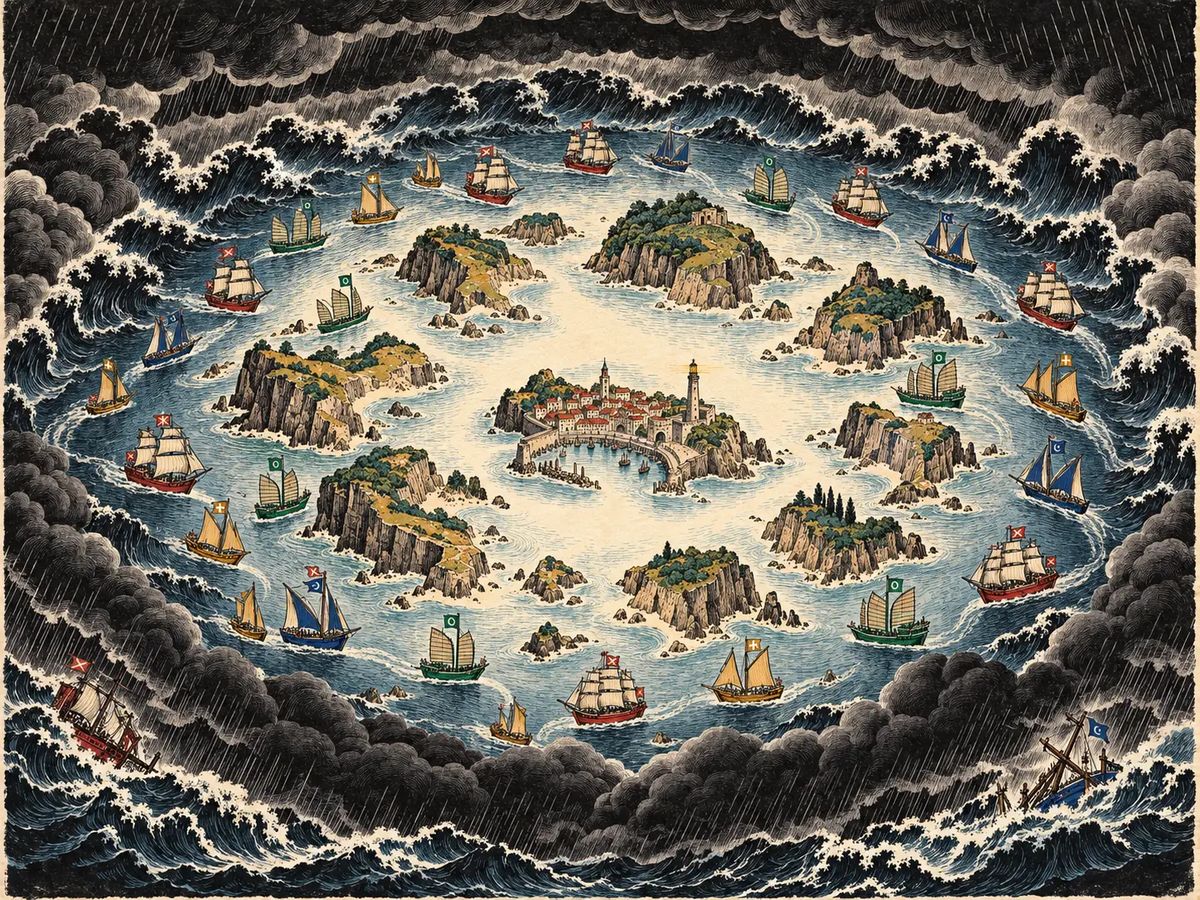
The custom of the sea: a ship hides what she is until she fights, and a fight tells the truth to the ships in it. The ships themselves, each doing what her namesake did: the Cutter scouts, the Fireship waits at anchor for someone to blunder into her, the Boarding Party takes what guns cannot, and the Admiral in his barge is the prize every enemy wants.
And the fog. You fight on what you can see from your own deck and what you can guess about the rest, and the best captain at the table is the one who guesses best.
What it inherits
More than a century of hidden-rank war games, from L'Attaque, a French parlour game published before the First World War,18 to the Stratego that generations of players grew up on. And the sealed, simultaneous orders of the classic negotiation games, where every player writes orders in secret and everything moves at once.
What it invents
The fleets and their flags. The archipelago, its harbors and its Capital. A single scale from 1 to 7, so the bigger number wins. A Privateer that can sink a First Rate. A storm that closes the chart ring by ring after rounds 13, 18, 22, so no game stalls into a standoff. An Admiral worth 8 points to whoever takes her.
And one reversal. In the old custom the flag lied and the guns told the truth. In False Colors the flag is always honest, and the ratings keep the secret.
Built to be played again
False Colors takes the best of a century of war games and answers the two things that kept them off the table: the wait for your turn, and the standoff. Every captain moves at once, so nobody waits and nobody gets the first shot. The storm closes in, so every game comes to a head.
Every rule had to earn its place. Over thousands of games and hours of playtesting, any rule that tilted a game was changed or cut, until what decides a game is nerve, memory and a well-timed bluff.
And it is built to be played again and again: a head-to-head duel or a six-captain melee, four ways to win, Pirates! with one captain against everyone, three charts, and a fleet you set up your own way every time, so no two games run alike.
For as many players as we can reach: free to play against rival captains in your browser tonight, free to print at home on letter paper, every rule written out in plain words, and a free digital beta for phones and the TV, invite only for now.
Here's to the next great game night.
Sources
- United States Navy, Marine Corps and Coast Guard, The Commander's Handbook on the Law of Naval Operations (NWP 1-14M), July 2007 (PDF, 2.2 MB), paragraphs 12.3.1 and 12.5.1.
- Instructions for defensively armed merchant ships, 20 October 1915, enclosed with a letter from the British Ambassador to the Secretary of State, 28 April 1916: Foreign Relations of the United States, 1916, Supplement, document 329, section B, rule 3.
- Institute of International Law, Manual of the Laws of Naval War, Oxford, 9 August 1913, article 15 (University of Minnesota Human Rights Library).
- San Remo Manual on International Law Applicable to Armed Conflicts at Sea, 12 June 1994 (ICRC treaty database), paragraph 110; the full text of the manual as mirrored by lagen.nu.
- Thomas Cochrane, Earl of Dundonald, The Autobiography of a Seaman, volume 1, chapter 5 (Project Gutenberg).
- National Park Service, Cape Hatteras National Seashore, Blackbeard (Edward Teach).
- Royal Museums Greenwich, Launch of fireships against the Spanish Armada, 7 August 1588, a painting of about 1590 attributed to Aert Anthonisz.
- University of New Brunswick, The Loyalist Collection, Letters of Marque: Declarations Against France, Spain, and the United Provinces (HCA 26/33-59), 1777 to 1783.
- The National Archives, HCA 26, High Court of Admiralty: Prize Court: Registers of Declarations for Letters of Marque.
- North Carolina Department of Natural and Cultural Resources, Queen Anne's Revenge Project, Blackbeard.
- Royal Museums Greenwich, Warship; Cutter; 12 guns, a model of about 1763 (SLR0510).
- Royal Museums Greenwich, Nelson Boarding the 'San Josef' at the Battle of Cape St Vincent, 14 February 1797.
- Royal Museums Greenwich, Warship; First rate; 100 guns, a model of a three-decker of 1735.
- Royal Museums Greenwich, HMS Victory.
- Fondation Napoléon, Villeneuve's Trafalgar despatch.
- Royal Museums Greenwich, Yonge family papers, on Sir Home Popham's signal code.
- National Library of Australia, James Cook's secret instructions.
- The British Antique Dealers' Association, L'Attaque game: designed by Hermance Edan, patent filed in France on 26 November 1908 and granted in 1909; and L'Attaque on Wikipedia, on its sale in France from 1910 and in Britain before the First World War.